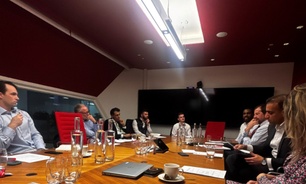
Eames Consulting hosted a roundtable in our London office on Thursday, 14th May, where Stephanie Coleman from our Corporate Functions team and I were joined by eight senior actuarial leaders from leading Lloyd's/London Market insurers.
The discussion (which was held under Chatham House rules) explored the impact of AI and a softening market on the evolving role of the actuarial function.
Here are key takeaways from the roundtable.
How are smaller or newer organisations building advantage in AI adoption?
An actuarial leader reported that 97% of employees had used AI at work, supported by open forums and internal showcase sessions.
Discussion explored the idea that newer or smaller organisations (including MGAs and startup syndicates) have a structural advantage, with fewer legacy data issues to contend with and the ability to build AI into operations from the ground up.
We also discussed how AI is reshaping team structures within the actuarial function. Leaders debated whether responsibility for AI in actuarial systems should sit with machine learning and data science teams or with a centralised AI function.
Junior AI dependency, use case limits, and timing raise concerns
AI use within junior actuarial teams divided opinion: while leaders welcomed emerging efficiencies and opportunities, some feared that junior actuaries could over-rely on “plug and play” tools without understanding syntax or the reasoning behind outputs.
Some leaders felt that understanding syntax isn’t necessary, while others argued that it is essential for validating outputs, especially when higher technical complexity is involved.
Discussion also explored the limitations of AI use, particularly in regulatory work, given how this domain’s high standards for accuracy require auditable, credible outputs.
Some leaders questioned timing, too, suggesting that the real benefits of AI for actuarial work may not be realised for another five years. A further insight for candidates was that actuarial leaders said they found it refreshing when spotting typos in CVs at the interview stage. Candidates who let AI do all the talking for them may sacrifice both accurate capture of their experience and the authenticity of human authorship.
What does a softening market mean for actuarial teams?
During the roundtable, leaders also shared how the softening market in 2026 is impacting actuarial teams.
A softening market increases the demand for actuarial work (increasing the need for rigorous analysis), while simultaneously creating pressure to cut headcounts as companies reduce expenses.
As many junior actuaries have never experienced a softening market before, there's a knowledge gap that senior leaders need to actively close.
Identifying opportunity under softening market conditions
The mismatch between growing workload and frozen headcount was flagged as precisely where AI can add value, potentially helping to absorb analytical demand without requiring additional hiring.
Leaders also anticipate needing to defend their teams. Given the back-office nature of the actuarial function and its vulnerability to cost-cutting, visibility and commercial positioning are key strategic priorities.
Offshore vs onshore resourcing and future skills required
The line between "offshore" and "onshore" is blurring in multinational teams. For many firms, it's simply where the team sits, not a cost-arbitrage decision.
UK-based actuaries were noted as more commercially minded than counterparts in other locations: a consideration when building distributed teams.
Time zone coverage is an underappreciated benefit for globally distributed teams. Having team members spread across zones ensures availability for meetings and turnaround rather than relying on narrower overlap windows.
Where actuarial talent needs to evolve next
Ultimately, actuaries need to become more adaptable, bridging underwriting, claims, and analytical functions. Although AI enhances the role, senior leaders agree it doesn't replace the commercial and interpretive human-led judgement at the function’s core.
Get in touch to join us for our next roundtable
These events are a great opportunity to connect with other leaders in your specialism and share knowledge around the current market pressures firms are facing. They deepen understanding of where actuarial teams need to focus and strengthen professional relationships across the market.
Many thanks to the actuarial leaders who joined us for the discussion. If you’d like to talk to me more about current trends in actuarial resourcing, want to bring in the right leader for your organisation, or are looking for your next opportunity in the sector, please get in touch with me.