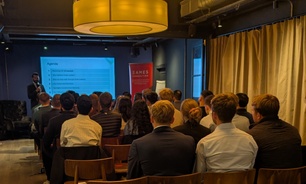
Across two roundtables in May and October 2026, Eames Consulting welcomed senior actuarial leaders working within the Lloyd’s/London Market to our offices in London to discuss optimising the actuarial function.
At the first roundtable in May, actuarial leaders told us how they expected AI and a softening market to impact their teams. By October, they were sharing what had actually come to pass.
Here’s how the conversation has evolved:
From prediction to practice: What best-in-class actuarial functions look like
Across both roundtables, senior leaders shared that in the future, best-in-class actuarial teams would:
- Bridge underwriting, claims and analytical functions
- Leaders shared that actuaries who sit closer to other areas of the value chain would be able to assist in making better informed, more risk-aware and commercially minded decisions.
- Use automation to enable higher-value work without losing critical commercial and human judgment
- One actuarial leader shared that 97% of employees in their organisation had used AI at work. Adoption, though, raised its own concerns: were junior actuaries learning the syntax and reasoning behind AI outputs, or just the shortcuts?
Leaders have also questioned the timing, suggesting that the real benefits of AI for actuarial work may not be felt for another five years.
How the conversation about best-in-class actuarial teams has evolved
By October's follow-up roundtable on optimising the actuarial function, the discussion of what best-in-class teams look like had shifted:
Leaders agreed that no single structure defines a best-in-class actuarial function. What matters more is that it is joined up: pricing and reserving working closely together and the whole function staying commercially engaged with underwriters.
Many firms have split pricing and reserving into separate roles. Benefits described include:
- pricing and reserving actuaries reviewing each other’s models
- reserving teams being able to communicate fluently with underwriters
- the entire actuarial function (not just pricing) being more commercially aligned
Focus is moving from individual cases to the wider portfolio. Pricing teams are shifting their focus from individual case pricing towards wider portfolio analysis, such as segmentation and line size optimisation. One leader said demand for portfolio models was coming directly from their CEO.
Case pricing remains fundamental, but leaders noted its limits in moving the dial.
Leaders also debate whether pricing and reserving responsibilities should be mixed or not. A key benefit for firms that have separated the two responsibilities: underwriters have not lost actuarial support during peak reserving periods.
Across both discussions, it emerged that best-in-class actuarial teams add value through:
- Cross-functional collaboration
- Not simply performing pricing and reserving responsibilities, but collaborating across domains to support stronger, broader business decisions continuously
- Human and commercial judgment
- Automation may mean that more accurate data is available faster, yet the commercial human judgment that comes from experience, such as deep understanding of edge cases, is hard for AI to replicate
Where AI is adding real value versus where it is raising concern
At both roundtables, we discussed where AI is adding value and saving time.
In May, some leaders suggested that AI’s real benefits for actuarial work might be five years away. By October, they were sharing concrete examples of use cases:
- a model change delivered using AI-written code
- teams building in-house alternatives to paid pricing platforms
One leader described training in prompt writing as “transformative”. Yet there is still a challenging difference between prototypes and enterprise-wide deployment.
Leaders also noted that limited risk appetite, cost and governance are restricting which AI tools teams can use. New York is preparing tighter AI laws, and with further regulation also on the horizon, leaders expect AI-related claims to grow, adding to the workload for insurers who cover AI risks.
This reinforces the need to invest in both technology and people.
The impact of AI: Junior dependency and fears of a skills and succession gap
Actuarial leaders also debated whether juniors need to understand the fundamentals or can rely on AI to fill in the gaps.
By the second event in this series, the concern about overreliance had a real example behind it. One leader described a graduate who used Copilot to apply standard reserving methods, then admitted at the Q3 reserving cycle that they didn’t understand how the methods worked.
AI literacy isn’t the whole picture either: the room noted that AI-confident juniors may still lack the confidence to engage underwriters and claims managers, which limits how far their work is adopted.
Leaders also shared a larger concern: the talent pipeline. Many firms have reportedly pulled back on graduate hiring because they’re unsure how to train juniors alongside AI. Graduates are also missing the “long way round” that once built their understanding.
If the trend continues, the market could be short of mid-senior talent within the next three to five years.
For now, though, attrition is low. One leader reported seeing almost none. Others said people are more cautious about moving, tending to leave only when they hit a progression ceiling. Leaders also suggested that actuaries may feel safer staying put than moving to an unknown role in a softening market while AI’s longer-term impact remains uncertain.
The continuing impact of the softening market
Earlier in 2026, senior actuarial leaders anticipated that they would need to defend their teams as margins came increasingly under pressure due to the softening market.
The actuarial function has often been seen as fulfilling a more ‘back office’ role, thus being more vulnerable to headcount pressure.
By the October roundtable, this concern was validated. Leaders shared:
- Firms are being more cautious with capital allocation compared to the softer market of ten years ago, with more multi-year capital thinking and hesitance to lean on investment return to justify pricing
- Actuaries are having to defend loss ratio and adequacy positions more, a skill leaders suggested had softened during the hard market
Insights on actuarial team structure and resourcing
Across both roundtables, there were several insights shared regarding ideal actuarial team structure:
- Pools versus specialists
- Leaders say pooled teams are more efficient, while line specialists build depth. In practice, underwriters want a consistent named contact, with an attendee sharing that pools drift toward key relationships anyway.
- Prioritising finding the right people over structure
- Several leaders argued the quality and curiosity of individuals matters more than structure or title. One approach, put simply: “Get good people and find roles for them”.
- Matrix models
- A group-level perspective favoured centralising more, for example standardising reserve committee packs, and adopting a matrix approach.
Under a matrix approach, each person would cover a business or legal entity on one axis and a cross-cutting responsibility on the other.
It was observed that this works well in capital and is harder to apply to reserving. Others described similar set-ups: reserving managers by portfolio crossed with regulatory reporting, such as technical provisions, or by product, region or legal entity.
Rotation of individual actuarial responsibility was supported to avoid key-person risk, although it was noted that this should be balanced against underwriters wanting continuity.
In Summary
Across both roundtables, one message was consistent: AI enhances the actuarial function, but it doesn’t replace the commercial judgement at its core.
As the market softens, that judgement is under more pressure than ever. Actuaries are defending their technical view, standing behind adequacy numbers, and showing the function’s value to the wider business.
Getting the most from the function beyond 2026 means investing in technology and people together. For actuarial leaders, that means building teams that work closely with underwriting, claims and finance, deciding where AI earns its place, and shaping how the next generation develops the judgement the role depends on.
If you would like to discuss building a best-in-class actuarial team, get in touch with Hannah or our team of actuarial specialists.